Carbon accounting where every figure is traceable

Carbonly helps UK businesses measure, report and reduce their greenhouse gas emissions. Upload the bills and invoices you already have and get an auditable emissions ledger, UK SRS-aligned disclosures, and reports your assurance provider can verify line by line.

Book a demo See the platform
The Carbonly emissions dashboard: totals by scope, hotspots by category, reporting periods compared
Measure · Report · Reduce

One ledger, three jobs

The product is organised the way the work is: capture activity data, turn it into disclosure-ready reporting, and manage the reductions that follow.
Measure — data in, without the spreadsheet grind

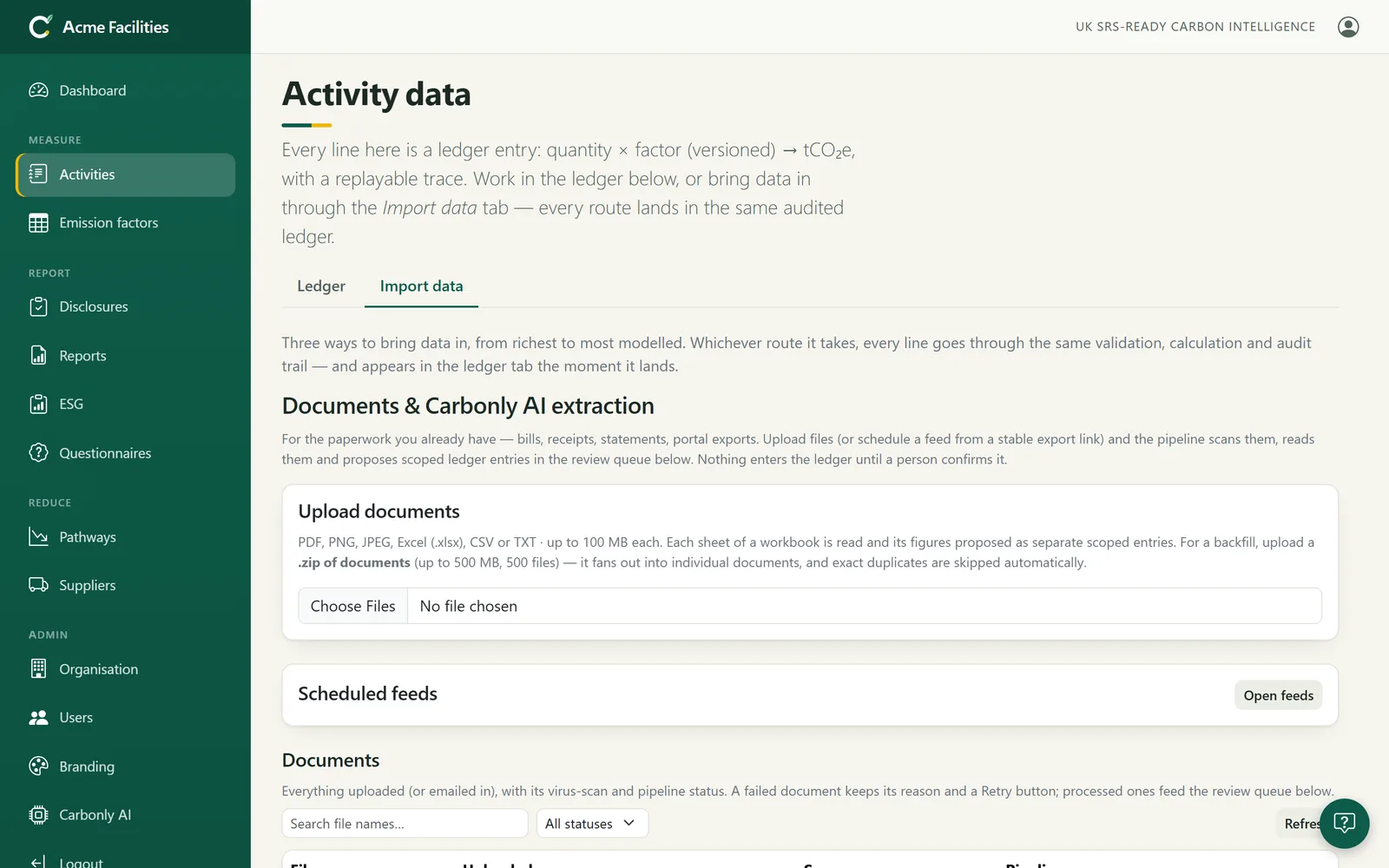
  • Upload the paperwork you already have. Bills, receipts, statements and portal exports — Carbonly AI reads each document and proposes a scoped ledger entry with its reasoning and confidence. Nothing enters the ledger until a person confirms it.
  • Every route lands in one audited ledger. CSV import, forwarded emails, supplier spend documents or manual entry — same validation, same audit trail.
  • Official Defra conversion factors, versioned. Each annual gov.uk release is imported automatically and applies to activity dated in its own year — publishing a new release never changes an existing figure.
Import data tab: document upload with Carbonly AI extraction and a human review queue

Report — UK SRS-shaped from day one

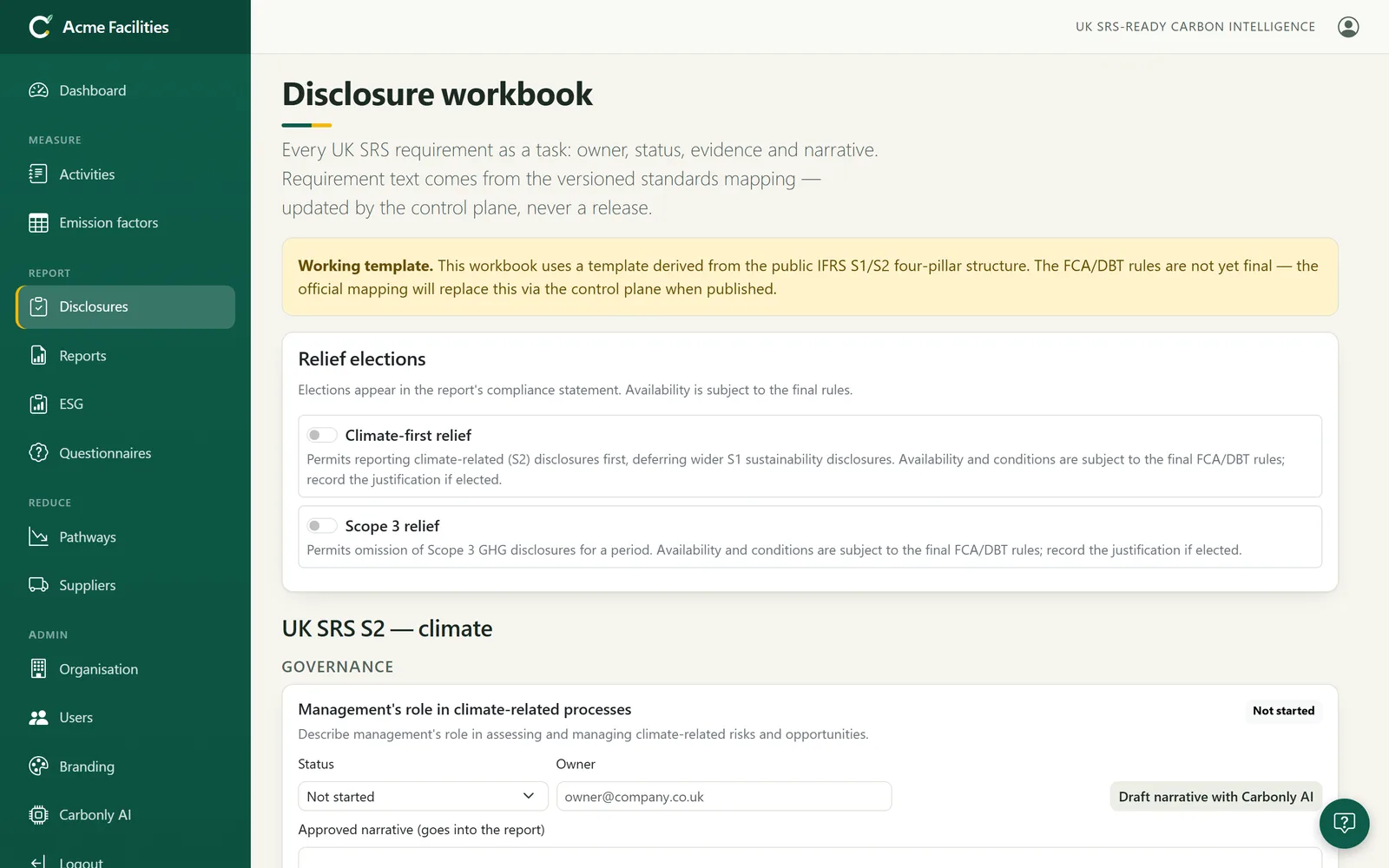
  • A disclosure workbook, not a blank page. Every requirement is a task with an owner, status, evidence and narrative — structured on the IFRS S1/S2 four pillars behind UK SRS, with relief elections recorded, not hidden. When the final FCA/DBT rules land, the mapping updates by configuration, not by release.
  • Branded PDF and DOCX reports with the methodology, engine version and factor-set checksums stated — plus Scope 2 shown both location- and market-based.
  • An audit pack your assurance provider will actually want: every figure, every calculation trace and every factor version in one zip.
Disclosure workbook: UK SRS requirements as tasks with owners, status and relief elections

Reduce — targets tracked against reality

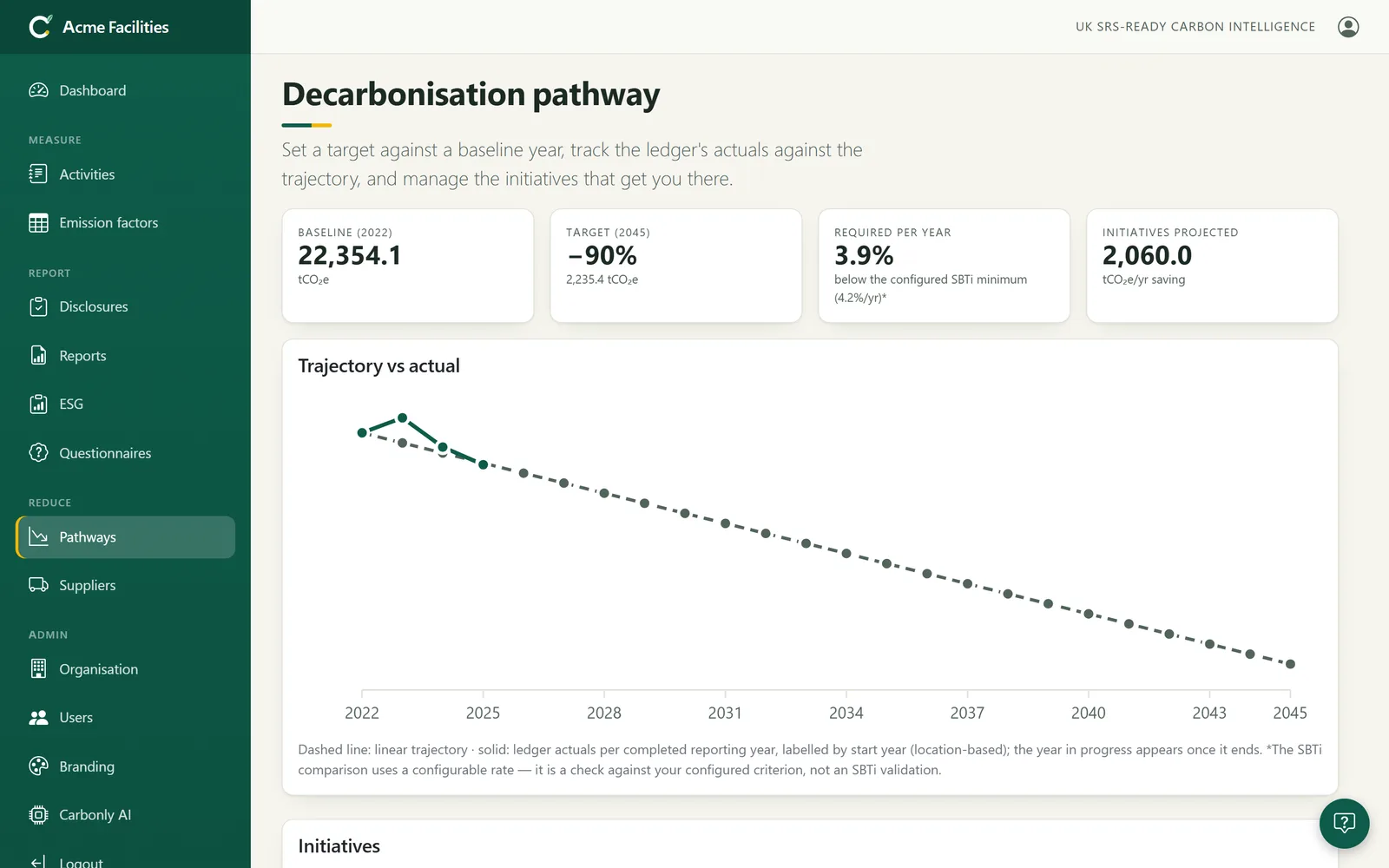
  • Decarbonisation pathways snapshot a baseline from your own ledger and chart actuals against the trajectory — with the required annual reduction checked against a configurable criterion such as the SBTi minimum rate.
  • Initiatives with owners, costs and projected savings, so the plan behind the line is visible.
  • A supplier portal that invites your suppliers to submit real product emissions — reviewed submissions become supplier-specific Scope 3 factors with full provenance.
Decarbonisation pathway: baseline, target trajectory and ledger actuals
Traceability

Auditable by construction

Every number in a Carbonly report can be walked backwards to what produced it. The calculation engine is deterministic and version-stamped; results are append-only, so recalculation supersedes — it never overwrites history.

Source documentActivity record Factor (set + version + checksum)Replayable trace ResultReport

Hash-chained audit trail

Every insert, update and delete writes a tamper-evident audit event — who, what, before and after, chained by hash.

Factors are data, never code

Conversion factors only exist inside versioned datasets published by the control plane. Nothing is hard-coded, nothing is invented.

Locked periods stay locked

Reported periods reject silent changes — corrections go through restatements with a recorded explanation.
Carbonly AI

Intelligence that stays inside your stack

  • Human in the loop, always. Carbonly AI suggestions carry confidence and reasoning; people accept, edit or reject — and every decision teaches the system.
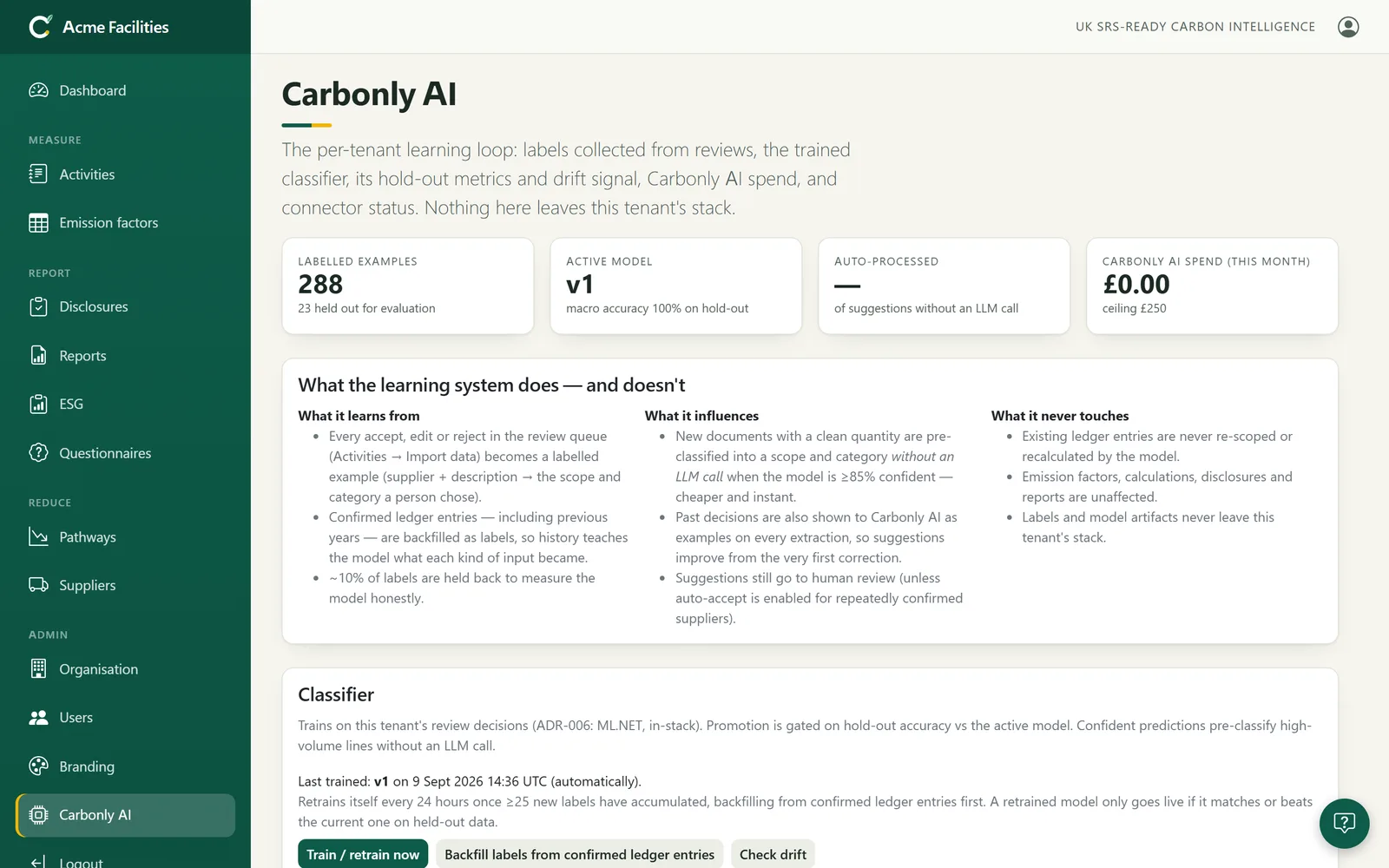
  • A classifier trained only on your data, promoted only when it beats the current model on held-out examples. Confident, repeat suppliers get classified with no model call at all — faster and cheaper.
  • Honest metrics on show: accuracy, drift and monthly Carbonly AI spend against a per-client cost ceiling, all on one dashboard. Your labels and models never leave your own environment.
Carbonly AI dashboard: labelled examples, model accuracy, spend against ceiling
Architecture

One isolated stack per client

Carbonly is not a shared database with a customer column. Each client runs their own deployment — isolation is physical, then enforced again in code.

Your own database

A dedicated PostgreSQL database per client — plus tenant-scoped query filters and an interceptor that treats any cross-tenant write as a security incident, not a bug.

Your own storage & queues

A dedicated object-storage bucket for evidence, reports and AI model artefacts, and dedicated message queues for the processing pipeline.

Your own applications

Web app, API and workers run as your own containers, with your branding, locale, reporting year and feature configuration — updated without redeployment.

Scalability

Provisioned in one step, portable by design

One command per client

A new client's entire stack — database, migrations, storage, queues, configuration and admin invitation — is provisioned by a single idempotent, resumable operation.

Runs where you need it

The same stack shape runs on a single server or on Kubernetes, so the platform grows with its clients rather than being rebuilt for them.

Factors keep themselves current

Annual Defra releases are detected, imported and published to every client automatically — each year's activity calculated against its own year's factors.

Security & trust

Built like it will be audited — because it will be

Strong sign-in by default

Invitation-only registration, mandatory multi-factor authentication, passkey support, bot protection and breached-password checks on every account.

Least privilege, visible

Role-based access down to individual pages — including a read-only Auditor role — with per-client SSO available by configuration.

A verifiable supply chain

Signed container images with a software bill of materials, dependency and vulnerability scanning in CI, and encryption in transit and at rest via the hosting platform. DPIA, disaster-recovery and penetration-test readiness packs included.

Frameworks

Enter data once, answer everyone

The ledger follows the GHG Protocol — all three scopes, all fifteen Scope 3 categories, Scope 2 dual reporting. Disclosure requirements cross-reference adjacent frameworks so the same data answers more than one question.

GHG ProtocolUK SRS S1/S2 (draft-aligned)SECR TCFDCSRD / ESRSCDPSBTi-style checks

The UK SRS workbook is structured on the public IFRS S1/S2 four-pillar framework while the final FCA/DBT rules are pending — Carbonly says so in the product, and the official mapping replaces the template by configuration the day it is published. Pathway checks against the SBTi rate are a configurable criterion, not an SBTi validation.

See it with your own data

A demo takes half an hour — bring a handful of real bills and watch them become an auditable ledger.

Book a demo